
Why can't the Indian government propose to the Chinese a corridor circumambulating the Holy Mountain where people from both sides could perform the yatra again? asks Claude Arpi.

The Global Peace Index 2017, by the Institute of Economics and Peace found that the global level of peace slightly improved, by 0.28 per cent in score. A total of 93 countries improved, while 68 countries deteriorated.

IS, especially active in northern Sindh and Balochistan, was also behind the abduction and killing of two Chinese nationals last year.

New Delhi has reached out to Moscow while waiting for a new president in Washington. New Delhi knows well that in international relations, there are no permanent friends or foes, only permanent national interests, points out Dr Rup Narayan Das.
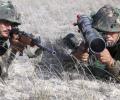
Here is how the two countries stack up militarily, according to a report in AlJazeera.com.

Times have changed, situations have changed, but the basic nature of superpower geo-politics remains the same and so also India's diplomacy -- call it non-alignment, strategic autonomy or neutrality; it all depends on the time scale, notes Rup Narayan Das.
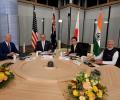
Saturday's Quad meeting in Delaware is taking place against the backdrop of China's assertive behaviour in the South China Sea, its sabre-rattling in the Taiwan Strait and increasing footprints in the Pacific and Indian Ocean, asserts Rup Narayan Das.
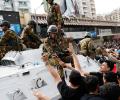
'At this moment you cannot give her asylum because if you do, then you are directing public anger against India.'

Beijing's political risks are also escalating because of a renewed wave of public anger in many parts of Balochistan against human rights abuses by Pakistani troops deployed to crush the low-intensity insurgency in the province, the report said.

A group of pro-Khalistani protesters on Sunday attacked and damaged the Indian consulate in San Francisco, prompting sharp condemnation from Indian-Americans who demanded immediate action against those responsible for it.

The scaling up of the India-US strategic partnership to the level of non-NATO ally with defence deals, sharing and transfer of defence technology, interoperability, joint collaboration and joint production of defence equipment has exacerbated Moscow's anxiety, notes Rup Narayan Das.

Although the credit for acquiring the technological skill must be given to India's outstanding nuclear scientists, the decision to go nuclear was a political one that entailed clarity of vision, courage and resolve, points out Rup Narayan Das.

'Israel is counting on the United States to enter the fray on their behalf and perform destructive strikes against these targets that are beyond Israel's conventional capabilities.' 'They may well get their way if they start a war, because the United States is still committed to Israel's security, and it won't matter whether it is Trump or Harris in the White House.'

'But he was very quick and did a very stylish adab.' 'Of course, I didn't expect him to hug.'
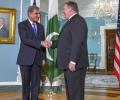
'We're paying them nothing because that's what they've done to help us. Nothing'

'Kashmir is the main issue between the two countries.' 'We have not been able to resolve it bilaterally.' 'As the two major countries in South Asia, we have to go back to the drawing board and start engaging.'

A ceremony to launch Pakistani teenage rights activist Malala Yousufzai's book was scrapped after the government of the restive Khyber-Pakhtunkhwa province said it could not provide security for the event.

'The future of BRICS is under stress as Chinese attempts to expand the platform are being resisted by India and Brazil.' 'Beijing is focused on a quick expansion with the aim of giving the platform a distinctly anti-Western orientation, which New Delhi and Brasilia seem to have no interest in,' notes Harsh V Pant.

'The world is watching carefully. The choices India makes today have consequences beyond its borders.'

'If Indian armed forces entered Pakistan and succeeded in inflicting major damage on the Pakistani army and occupied territory in the Pakistani heartland, there is reason to think the Pakistani military would use some nuclear weapons against the incoming Indian forces to compel India to stop.'

'The message to India is (with attacks like Pathankot) basically what the Pakistani army is trying to test is how serious are you when it concerns the peace process with that country.'

All Pakistani moves towards peace will be seen as tactical compromises, to be abandoned when the situation changes, observes Colonel Anil A Athale (retd).

Captain Anshuman Singh sacrificed his life saving the men entrusted to his medical care in the highest traditions of doctors that serve in the military.

'In today's world, it is difficult for public pressure to work against a country like India.'
'Given the present force levels, India cannot fight and win.' 'India can't hope to terminate the conflict on India's terms and impose the nation's will upon the adversaries,' says Brigadier Gurmeet Kanwal (retd).

'This incident offers ammunition to those inside the US government and elsewhere who question the wisdom of trusting India, so it will have a lasting consequence no matter how it is managed.'

Over 85 per cent of Pakistanis want relaxation in visa policies between Pakistan and India, a new survey has revealed. This was disclosed by the Institute for Peace and Secular Studies during its signature campaign in five big cities of Pakistan.

Rediff.com present a comprehensive listing of the nuclear nations and their collective and active stockpile.

'By beheading an Indian soldier, the Pakistan army has demonstrated its proclivity for barbaric medievalism.' 'The strategies adopted and the punishment inflicted by India must be made progressively more stringent with every new act of terrorism till the cost becomes prohibitive for Pakistan,' says Brigadier Gurmeet Kanwal (retd).
To be sure, Modi is no Vajpayee; at least that is the impression he gives. However, this doesn't mean that he will be looking for a fight. All it means is that if Pakistan seeks a fight, he will not back down. What it also means is that the pusillanimous approach of the previous governments to ceaseless provocations from Pakistan will probably change, says Sushant Sareen.

It would be foolish for Pakistan to assume that India would not act no matter what the provocation is, just because it is militarily more powerful than Myanmar and is armed with nuclear weapons, says Anand Kumar.

'Openness is a great weapon in the armoury of more open societies. That's why the fight with Pakistan isn't just about India be six times bigger, but equally bitter and insecure Pakistan,' argues Shekhar Gupta.
'After General Raheel Sharif took on the Tehrik-e-Taliban Pakistan, some sections of the military establishment may have felt unease as to whether the crackdown could be extended against friendlier 'non-State' actors like the Lashkar-e-Tayiba.'

It is a timely reminder that when faced with twin threats, India has succeeded by wisely choosing allies, points out Colonel Anil A Athale (retd).

After two decades, the SCO appears to be at a cross-roads with the US withdrawal from Afghanistan, asserts Srikanth Kondapalli, the leading China expert.

'A collapsing Pakistan may well unleash its nuclear weapons as the last throw of the dice. With a nuclear arsenal of over 50 bombs, even a regional nuclear exchange can devastate the world.'

Today, the two countries, ruthlessly divided by the Radcliffe line that pierced their very heart, grapple with the political challenges of the present. Yet, when friendships develop there are no borders, observes Payal Singh Mohanka.
Pakistan's nuclear arsenal is 'simply a deterrent' to protect the country and there will no longer be any need for it once the Kashmir issue is resolved, Prime Minister Imran Khan has said as he asserted that if the Americans have the resolve and the will, the issue can be sorted out.
'A conventional war is not in fashion today and not seen as being able to deliver the objective.' 'Perhaps surgical strikes that are deeper, this time not on Pakistan's terrorist facilities, but on Pakistan army facilities.' 'The nation has to be prepared for losses.' 'War is not something that can be pussyfooted around.' 'If we go for limited number of posts in Kashmir, these are very difficult posts to capture and very difficult operations.' 'Be prepared for 200 to 300 killed.'

'Pakistan has worsted India in the Afghan proxy war and the defeat becomes a template of regional politics,' points out Ambassador M K Bhadrakumar.
